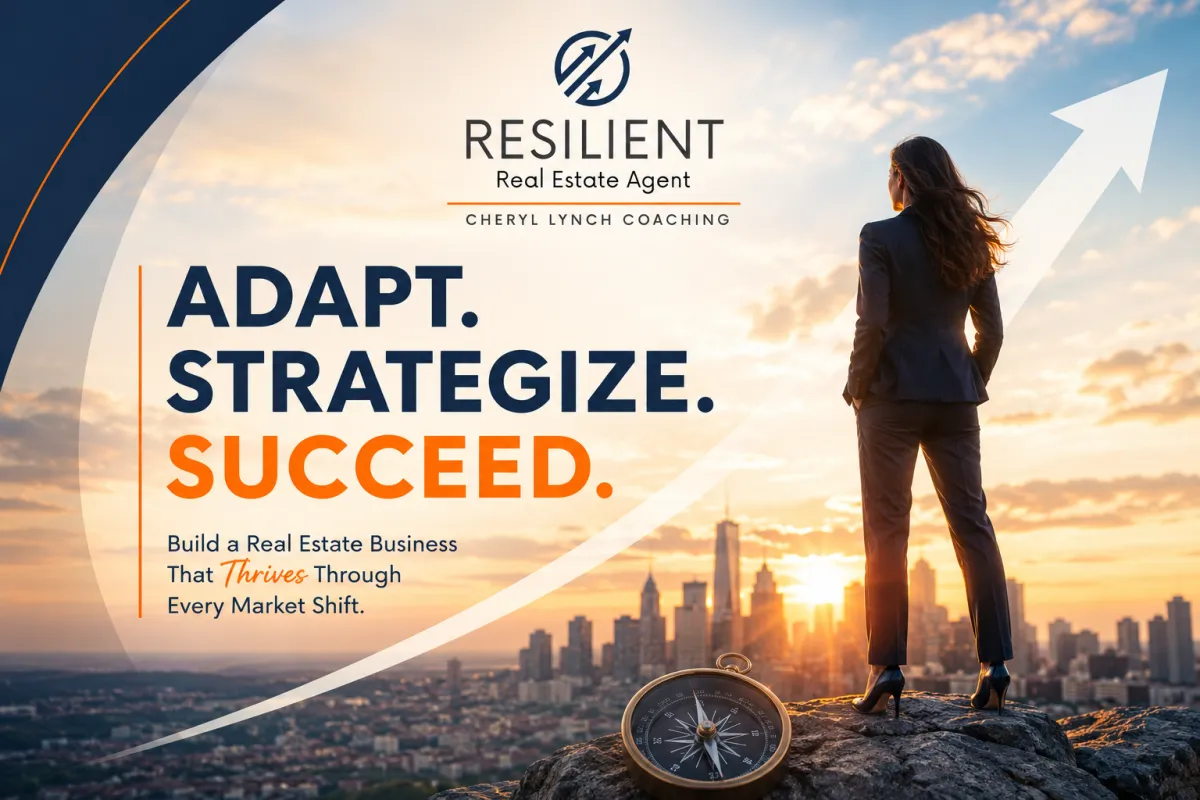
Why Adaptability Is Your Greatest Business Advantage
How the most successful agents build businesses that thrive through market shifts, industry disruption, and changing consumer expectations
If there is one lesson I have learned after more than two decades in real estate, it is this: the agents who build lasting success are not necessarily the most talented, the most connected, or even the most experienced.
They are the most adaptable.
Over the years, I have watched the industry transform repeatedly. I have seen markets surge and contract. I have seen interest rates climb, fall, and climb again. I have watched technology reshape how consumers search for homes, how agents market properties, and how relationships are built. Most recently, artificial intelligence has entered the conversation, creating both excitement and uncertainty about the future of the profession.
Through every shift, there has been a consistent pattern.
Some agents spend their energy wishing things would return to the way they were.
Others focus on understanding where the industry is going next.
The difference between those two approaches often determines who continues to grow and who struggles to keep up.
That is why resilience has become one of the most important business skills a real estate professional can develop. Not resilience in the traditional sense of simply enduring challenges, but resilience as a strategic advantage. The ability to adapt, evolve, and continue moving forward regardless of external circumstances has become one of the defining characteristics of long-term success in real estate.
The future will not belong to the agents who are best at predicting change. It will belong to the agents who are best prepared to respond to it.
The Real Estate Industry Has Never Been Static
Many newer agents enter the business believing that success comes from finding the perfect system and executing it consistently. While consistency is important, experience teaches a different lesson.
The real estate industry is constantly evolving.
Consider how dramatically the profession has changed over the last twenty years. There was a time when newspaper advertising was a primary source of exposure. Open houses looked different. Marketing materials were produced differently. Consumers relied heavily on agents for information because access to listings was limited.
Today, consumers can access more information from their smartphones than buyers could access in an entire office just a couple of decades ago.
Then came the housing crisis of 2008.
Many agents who had built businesses during a strong market suddenly found themselves facing entirely different conditions. The strategies that worked previously were no longer enough. Some adapted and found new opportunities. Others waited for conditions to improve.
The same thing happened during the pandemic-driven housing boom. Buyers competed aggressively. Inventory became scarce. Homes sold quickly. Yet even that environment eventually changed.
Today, agents are navigating higher interest rates, affordability concerns, changing commission conversations, and rapidly evolving technology.
The lesson remains the same.
Every market rewards adaptability.
The agents who continue growing understand that no market condition is permanent. They recognize that every cycle requires a different approach, and they remain flexible enough to adjust without abandoning the fundamentals that create long-term success.
Why Some Agents Continue to Thrive While Others Struggle
One of the most fascinating aspects of real estate is watching how different professionals respond to the exact same environment.
Two agents can operate in the same city, work within the same market conditions, and have access to similar resources. Yet one continues generating opportunities while the other experiences stagnation.
Why?
The answer often has less to do with skill and more to do with perspective.
The agents who thrive tend to ask different questions.
Instead of asking, "Why is the market doing this?" they ask, "How should I adjust my strategy?"
Instead of focusing on what has become more difficult, they focus on what opportunities now exist.
Instead of spending time comparing current conditions to previous years, they focus on serving today's consumer more effectively.
This shift in thinking creates a significant competitive advantage.
Resilient agents understand that every challenge creates new opportunities. A changing market often reveals needs that did not exist before. Buyers require additional education. Sellers need more strategic guidance. Consumers value expertise more when uncertainty increases.
Rather than seeing change as a threat, resilient agents learn to view change as an opportunity to demonstrate value.
That perspective alone can transform how a business performs during uncertain times.
The Three Reinventions Every Successful Agent Experiences
After years of observing top-performing professionals, I have noticed that nearly every successful real estate agent reinvents themselves multiple times throughout their career.
The first reinvention usually happens during the production phase.
This is when agents learn how to generate business consistently. They develop systems, build relationships, and establish their presence within the marketplace. Most agents spend years refining these skills.
The second reinvention often occurs when agents begin thinking like business owners instead of salespeople.
At this stage, the focus expands beyond transactions. Systems become more important. Operational efficiency matters. Leadership skills begin to influence results. Time management, delegation, and strategic planning become essential components of growth.
The third reinvention is often the most meaningful.
This is when agents begin thinking about long-term impact and legacy. They move beyond simply generating business and start focusing on building something sustainable. They mentor others. They strengthen their communities. They create businesses that can continue evolving as the industry changes.
What makes these reinventions possible is adaptability.
Agents who remain attached to a single identity often struggle to grow. Those who embrace evolution discover new opportunities that align with changing markets, changing goals, and changing priorities.
Growth requires reinvention.
Reinvention requires resilience.
Building a Business Around Principles Instead of Tactics
One of the biggest mistakes agents make is building their business around tactics rather than principles.
Tactics change constantly.
At various points in the industry, agents have relied heavily on newspaper advertising, direct mail, farming, online lead generation, social media, video marketing, paid advertising, search engine optimization, and countless other strategies.
Each tactic has its moment.
Each tactic eventually evolves.
The most resilient agents understand that tactics are simply tools.
The real foundation of a successful business is built on principles.
Trust.
Communication.
Consistency.
Expertise.
Visibility.
Relationship building.
Exceptional service.
These principles remain valuable regardless of market conditions or technological advancements.
Consumers may discover agents through different channels than they did ten years ago, but they still choose professionals they trust.
They still want guidance.
They still want expertise.
They still want confidence during one of the largest financial decisions of their lives.
When agents focus exclusively on tactics, they often find themselves chasing the next trend. When they focus on principles, they create businesses capable of adapting to whatever comes next.
Leadership Becomes More Important During Uncertainty
One of the greatest opportunities for real estate professionals emerges during periods of uncertainty.
When consumers feel confident, they often need information.
When consumers feel uncertain, they need leadership.
This is where resilient agents separate themselves from the competition.
Leadership is not about having every answer. It is about helping people make informed decisions despite uncertainty.
The most respected professionals communicate clearly. They educate consistently. They provide context. They remain calm when others become reactive.
Whether working with buyers, sellers, team members, or business partners, resilient leaders create stability through their presence and expertise.
Clients notice this.
Communities notice this.
Teams notice this.
Over time, that leadership compounds into trust, referrals, and reputation.
In many ways, resilience and leadership become inseparable. The ability to remain focused, adaptable, and solution-oriented during challenging circumstances strengthens both personal effectiveness and professional influence.
The Future Belongs to Adaptable Agents
There has never been a time in real estate when change moved as quickly as it does today.
Technology continues evolving.
Consumer expectations continue shifting.
Marketing platforms continue changing.
Economic conditions continue influencing behavior.
The pace of transformation is unlikely to slow down.
For some agents, that reality feels overwhelming.
For others, it creates opportunity.
The professionals who will lead the next decade of real estate are not necessarily the ones with the largest databases, the biggest teams, or the most sophisticated technology.
They are the ones who remain committed to learning.
They are willing to evolve.
They understand the importance of strong systems.
They focus on relationships instead of shortcuts.
Most importantly, they recognize that adaptability is not merely a survival skill. It is a growth strategy.
The future belongs to agents who can embrace change without losing sight of what matters most.
Final Thoughts
After more than twenty years in real estate, I have become convinced that resilience is one of the most valuable assets a professional can possess.
Not because it helps you survive difficult markets.
Not because it helps you overcome challenges.
But because it allows you to continue growing regardless of circumstances.
Markets will change.
Technology will evolve.
Consumer behavior will shift.
New opportunities will emerge.
The agents who continue succeeding will be those who understand that adaptability is not a temporary response to change. It is a permanent business advantage.
The goal is not to build a business that only works when conditions are ideal.
The goal is to build a business capable of thriving through every market cycle, every industry shift, and every new opportunity that lies ahead.
That is the true power of becoming a resilient real estate agent.